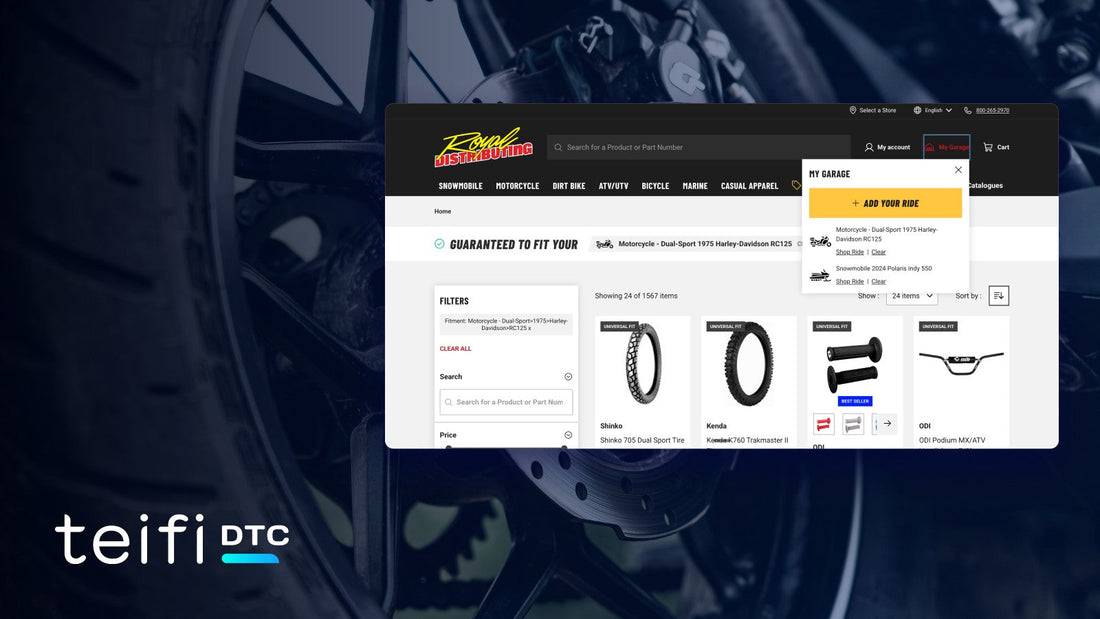

Today we are launching the Teifi DTC Commerce Suite for direct-to-consumer (DTC) brands whose growth keeps adding manual work behind the storefront. Stock gets verified after checkout. Configured products arrive as order notes, and support confirms fitment by hand. Every new region or warehouse adds one more check.
The Suite extends Shopify with the operating rules a valid order depends on, with Teifi Bridge, our integration layer, under every build and four optional modules for configuration, fitment, recommerce and service. Shopify stays the platform. We extend it around the way your business sells.
These patterns already run in production. Royal Distributing sells direct on Shopify from a catalog of over a million variant SKUs. Furniture retailer homenature reports a 90% reduction in order management costs compared to their previous solution.
Why complex DTC needs more than a storefront
Customers expect accurate stock, valid configurations, confirmed fitment and a delivery date the business can meet, and when installation or service follows the purchase, they expect that work on the order from the start.
Inside the business, the answers live in different places. Shopify holds the storefront and the transaction, while an ERP or warehouse system controls stock and fulfillment, product attributes sit in a product information management (PIM) system and configuration rules live in a spreadsheet. Trade-ins run on their own. Service opens a new record after checkout.
The cost lands twice. Operations teams interpret orders and repair customer promises by hand. Engineering inherits another integration or exception path with every product type, warehouse or acquisition.
Shopify handles complex DTC well once it can reach the rules behind each order.
Built from enterprise Shopify delivery
“For enterprise retailers, a Shopify launch depends on more than the storefront. It depends on the Shopify commerce layer before and after the buy button: loyalty & promotions, data model, order orchestration, payments, tax and financial reconciliation, all connected around the customer journey. Speed at this scale comes from Teifi’s delivery accelerators, proven patterns and deep enterprise-stack expertise.”
Peter Tivy, Founder, Teifi Digital
Peter wrote that after the M·A·C US launch on Shopify. The site went live 120 days from kickoff, and M·A·C's loyalty program, with millions of members, moved to the new platform in the same launch. Two more sites have followed. maccosmetics.co.uk has joined maccosmetics.com on Shopify, and clinique.com is now live on Shopify as well. Teifi Digital is the systems integrator on The Estée Lauder Companies' commerce transformation. Direct brands with smaller teams face the same test at their own scale: the storefront is ready long before the systems around it are.
What the DTC Commerce Suite adds to Shopify
Every deployment is built on Teifi Bridge. ReSelly, Teifi CPQ, Teifi Parts and WorkMate come in only when the business model calls for them. Each one starts from the handoff it removes.
Keep storefront promises aligned with the systems of record
A storefront that shows stock the warehouse no longer holds sells an order someone has to cancel. Most brands patch the gap with nightly exports and point-to-point scripts that rarely announce when they stop working, so a failed sync tends to surface as a canceled order and an apology email.
Teifi Bridge retires those scripts. It keeps Shopify and your ERP in step in both directions, from inventory and pricing to customers and orders. It ships with pre-built connectors for NetSuite, SAP S/4HANA and Microsoft Dynamics 365. Automated alerts flag a failed sync before it reaches a customer. The ERP stays the authority. Shopify gets what it needs at the moment of sale.
Turn configured products into orders the back office can use
When a product cannot be expressed as a fixed list of variants, the specification tends to land as a note that someone rekeys after checkout.
Teifi CPQ holds valid options and component pricing as structured data. Options draw on components you already stock and price. A quote can go back and forth before checkout. The agreed build lands on the order as one line production can read, so nobody retypes a specification from memory.
Confirm fit before the part reaches the cart
In automotive, powersports and other parts-heavy categories, a part that is in stock but does not fit is a return waiting to happen.
Teifi Parts brings fitment and compatibility data into search and product pages. A shopper confirms the part fits their vehicle before adding it to the cart, and saved fitment carries that vehicle into every future visit.
At Royal Distributing, the largest powersports distributor in Canada, compatibility once needed manual validation. When the check was missing or wrong, Royal absorbed the cost in wrong-part returns, support load and lost repeat business. Teifi rebuilt Royal's fitment architecture on Teifi Parts, and a 1M+ variant SKU catalog drawn from more than 700 vendors now resolves 1.27 million vehicle-to-SKU compatibility links. MyGarage keeps a returning rider's vehicles saved. Fit is settled first.
Add recommerce without creating a second customer record
Trade-in programs often start outside the store, with values in a spreadsheet and store credit issued by hand.
ReSelly runs trade-in, buy-back, consignment and resale inside Shopify. Intake, grading and store credit stay on the original customer record, and graded stock goes back into the catalog as sellable inventory. Recovered stock sells again.
Keep post-purchase work attached to the Shopify order
When a sale creates work after checkout, the job often moves into a second system and loses the customer on the way.
WorkMate keeps custom builds, installs, rentals and repairs on the same Shopify order and customer record. It raises purchase orders against the work that needs them and tracks rentals and service from intake to pickup.
Before WorkMate, homenature kept one inventory database for Shopify and another for furniture orders. Crucial details on custom pieces were sometimes lost between departments, and lead times stretched while customers waited for answers nobody could find in one place. On WorkMate, homenature cut total order management time by 25% and reports a 90% drop in order management costs compared to their previous solution. Orders process 50% more efficiently.
“WorkMate removes the second database, allowing us to leverage Shopify as a single source of truth.”
Robert Morrison, Senior Consultant, homenature
Who the Suite is for
The Suite is built for established brands with real ecommerce revenue, an ERP or other system of record, and a digital growth team.
Complexity is the signal. The strongest fit runs several kinds at once: more than one brand or region, stock spread across warehouses, and product rules that live outside Shopify.
The clearest signal is an ordinary order that someone validates by hand before it ships. Others follow close behind: duplicate product records, a support team confirming compatibility, and an integration the team trusts a little less after every expansion.
Not every DTC brand needs this. A straightforward catalog with one source of inventory and simple fulfillment is well served by Shopify and a focused app stack.
Start with the first expensive handoff
Every deployment starts on Teifi Bridge. The first module follows the handoff that costs the most today: Teifi Parts for a parts brand fighting returns, Teifi CPQ for a made-to-order brand rekeying specifications, ReSelly for a retailer adding trade-in, or WorkMate where service follows the sale.
One module is enough to start.
Find the customer promise that depends on a rule living outside Shopify today. Then trace who interprets that rule, which system owns it and what happens when the handoff fails.
Common questions
What is the Teifi DTC Commerce Suite?
The Teifi DTC Commerce Suite extends Shopify for direct brands with complex operations. Every deployment runs on Teifi Bridge to connect Shopify with your systems of record. ReSelly, Teifi CPQ, Teifi Parts and WorkMate are added when the business needs recommerce, configuration, fitment or service.
Can Shopify support complex DTC operations?
Yes. Shopify supports complex DTC once it has structured access to the rules each order depends on, from ERP inventory to configuration, compatibility and service data.
Is this a replatforming offer?
Not necessarily. The Suite can extend an existing Shopify operation or form part of a move onto Shopify. The starting point is the operating requirement, not a predetermined platform project.
Which systems can the Suite connect?
Teifi Bridge has pre-built connectors for NetSuite, SAP S/4HANA and Microsoft Dynamics 365, plus warehouse, third-party logistics (3PL) and custom API connections. The exact architecture depends on which system stays authoritative for each kind of data. Bridge also works alongside the Shopify integration partners a brand already relies on.
If your storefront is making promises your back office cannot reliably keep, start with the handoff costing your team the most time, margin or trust. The DTC Commerce Suite is live today with direct brands in four categories, from powersports parts to made-to-order furniture.
Map your first handoff with our team
Complex commerce, simplified.