
In Part 1 of this series we laid out the architecture challenge for automotive commerce on Shopify: fitment needs to live in the data model, not in a connector layer; buyer types need to run on one platform, not fragmented stacks; and the integrations that hold the business together need to be connected, not replaced.
This piece goes one level deeper. What does "fitment in the data model" actually mean? What does the fitment infrastructure have to handle to stay accurate at enterprise scale? And what sits on top of fitment once it's structural - ERP sync, buyer-specific pricing, order routing, and the broader ecosystem tools that amplify everything above?
Teifi Parts: The Fitment Layer
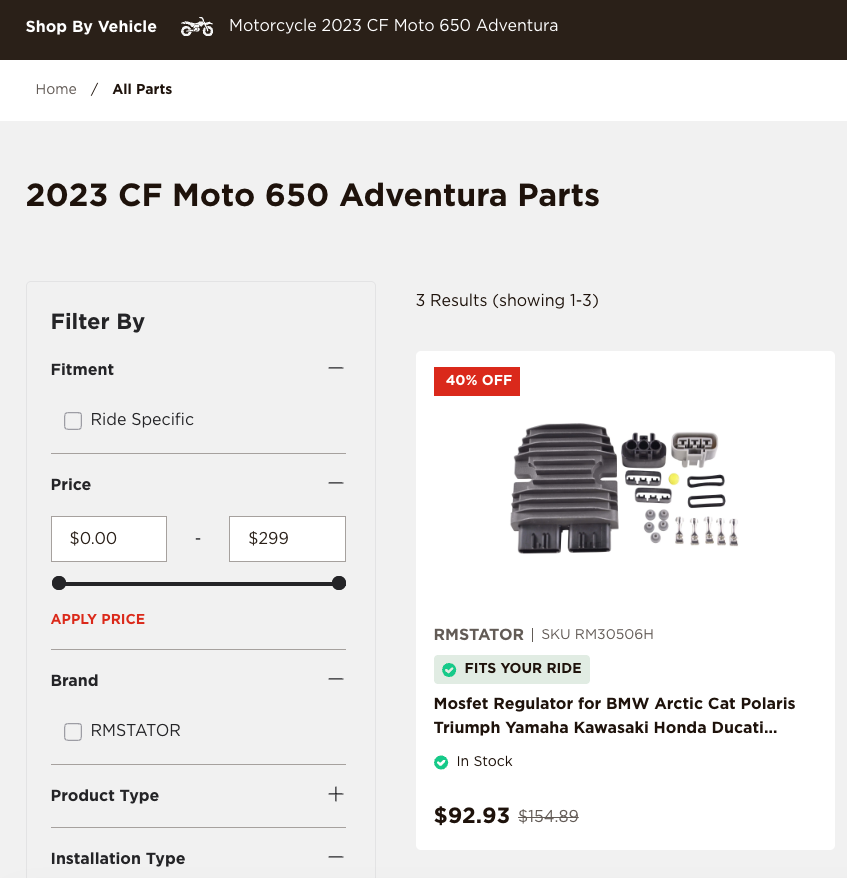
Fitment infrastructure means a dedicated fitment index running alongside Shopify's product metafields - not an app, theme block, or widget sitting on top of the storefront. YMM compatibility data is stored as structured metafields on the Shopify product record, queried by Elasticsearch at sub-10ms response, and kept current through event-driven sync that propagates vendor feed updates and ERP pricing changes in real time. A buyer's vehicle selection persists across PLP, PDP, cart, and search without requiring a re-query at each step. When fitment is structural at this level, every other layer in the stack operates against accurate compatibility data from the moment a buyer identifies their vehicle.
Teifi Parts handles the fitment-specific layer within the broader architecture. It embeds YMM intelligence into Shopify's data model - connected metafields, not middleware - and powers the buyer-facing experience: persistent vehicle selection across collections, search, and PDPs, real-time "Fits / Doesn't Fit" confirmation, fitment-aware cross-sell, and MyGarage for returning customers with multiple vehicles.
The commercial impact of getting this right shows up clearly in the growth model. Boost Auto built a $1M+ aftermarket parts business on Shopify starting from a single product line - truck mirrors - and scaling to a 50,000 sq ft operation with 340,000+ customers served. 60% of revenue now comes from diversified product lines beyond the original category, driven by fitment-powered cross-sell and product discovery. Less than 1% of revenue goes to advertising. The growth engine is fitment-accurate product discovery and organic search. When every product page, every collection, and every search result responds to the buyer's vehicle, the catalog sells itself.
The data pipeline normalises fitment data from wherever it lives today: ACES/PIES XML feeds, SEMA Data Co-op files, ERP and PIM outputs - whether that's Akeneo, Salsify, or a proprietary system - CSV exports, and custom databases. All of it resolves into unified YMM mappings. Direct-fit and universal-fit products surface together in a single ranked result, powered by Elasticsearch at sub-10ms query response regardless of catalog size. Teifi Parts also integrates with third-party search providers like Algolia and SearchSpring, so the fitment layer strengthens whatever search and discovery tooling the business already runs.
Two Technical Decisions That Define Whether Fitment Holds at Scale
Catalog mutation handling. When a vendor sends a feed spike - 50,000+ record changes in a single push - the fitment index needs to absorb it without storefront disruption. Teifi Parts handles indexing lag and feed spikes through incremental reindexing rather than full catalog rebuilds. The storefront continues serving accurate results from the current index while the updated data processes in the background. No downtime. No stale results visible to buyers during the update window.
Per-client isolation. Each Teifi Parts deployment runs in its own isolated Kubernetes environment - not a shared-tenant instance. This means one client's feed spike, catalog mutation, or indexing load doesn't affect another's performance. It also means the architecture can be configured per-client without cross-contamination risk - critical when fitment data structures vary significantly between automotive verticals (powersports YMM mappings are structurally different from replica wheel bolt pattern data).
"Indexing and feed spikes are architecture problems, and the platform handles those. The one that stalls projects is governance: when two vendor feeds disagree about the same part number, who on the business side decides which one wins? If that answer doesn't exist before go-live, it gets made by whoever's on support that day, and it gets made differently the next time. That's a decision to settle early, not at cutover."
Jess Lancaster, Director of Enterprise Solutions
The Full Stack: What Sits on Top of Fitment
Accurate fitment is the foundation. But an automotive business doesn't run on fitment alone - it runs on everything built on top of that foundation.
Real-time ERP and PIM integration. Vendor feed updates, pricing changes, inventory movements, and new SKUs propagate to Shopify automatically - not on a schedule, not through manual re-entry. Proprietary systems get connected, not replaced. The business keeps its existing product intelligence and gets a single source of truth it never had before.
Unified buyer experience. Every buyer type runs on the same platform. Wholesale and dealer customers access account-specific pricing and purchasing workflows - dealer-net pricing, MAP enforcement, territory tiering, and contract logic all governed from a single source rather than maintained separately across channel systems. Consumers get a DTC experience that feels native. In-store associates work from the same catalog, inventory, and fitment data. No separate storefronts. No duplicated logic.
Special order and fulfillment routing. For businesses managing hundreds of vendor relationships, order routing logic directs each order to the correct vendor or fulfillment path automatically - no manual triage, no staff intervention.
Ecosystem amplification. Because the commerce foundation is unified, every tool in the stack performs at a higher level. Search and discovery through Algolia returns fitment-accurate results, not just keyword matches. Product data governance through Salsify feeds directly into the fitment layer without manual translation. Tax compliance through Vertex operates correctly across every buyer type because they all run on one architecture, not separate stacks with separate logic. The same holds across the full ecosystem - whatever tools your stack is built on, a unified foundation raises what everything above it can do.
Royal Distributing: The Full Stack in Production

This is what it looks like in practice. Royal Distributing - Canada's largest powersports distributor - runs 1M+ SKUs across 700+ vendor relationships on a single Shopify architecture that Teifi built. Wholesale, DTC, and physical retail unified for the first time. Integration with Royal's proprietary fitment engine and PIM - decades of powersports compatibility knowledge connected rather than replaced. YMM persistent fitment search powered by SearchSpring delivering vehicle-accurate results across 1.27 million vehicle-to-SKU compatibility links. Special order routing handling vendor complexity automatically across all 700+ relationships.
Before the migration, Royal's team spent hours daily reconciling data across disconnected systems. Now, every buyer type - wholesale dealer, retail consumer, in-store associate - operates from the same catalog, the same inventory truth, and the same fitment data.
Ready to Evaluate Your Fitment Architecture?
If your fitment logic lives in a connector layer, or if search and discovery tools are operating against stale or incomplete data, the symptoms are predictable: wrong-part returns, zero-result pages on high-intent searches, and engineering cycles going to connector maintenance rather than commerce improvement.
Teifi's Fitment Architecture Assessment is a 60-minute diagnostic that maps where your fitment data lives today, what breaks at catalog scale, and what a unified architecture would look like for your business.
Book your Fitment Architecture Assessment
Other posts in this series:
- Part 1: Shopify for Automotive: One Architecture, Every Buyer Type. Why unified commerce for automotive is an architecture problem, not a platform problem - and the Three Places Fitment Breaks framework every automotive commerce leader should know.
- Part 3: Why the Fitment Data Moves Before the Storefront. The fitment-first migration framework, with OE Wheels and Royal Distributing as live proof points. Coming soon.