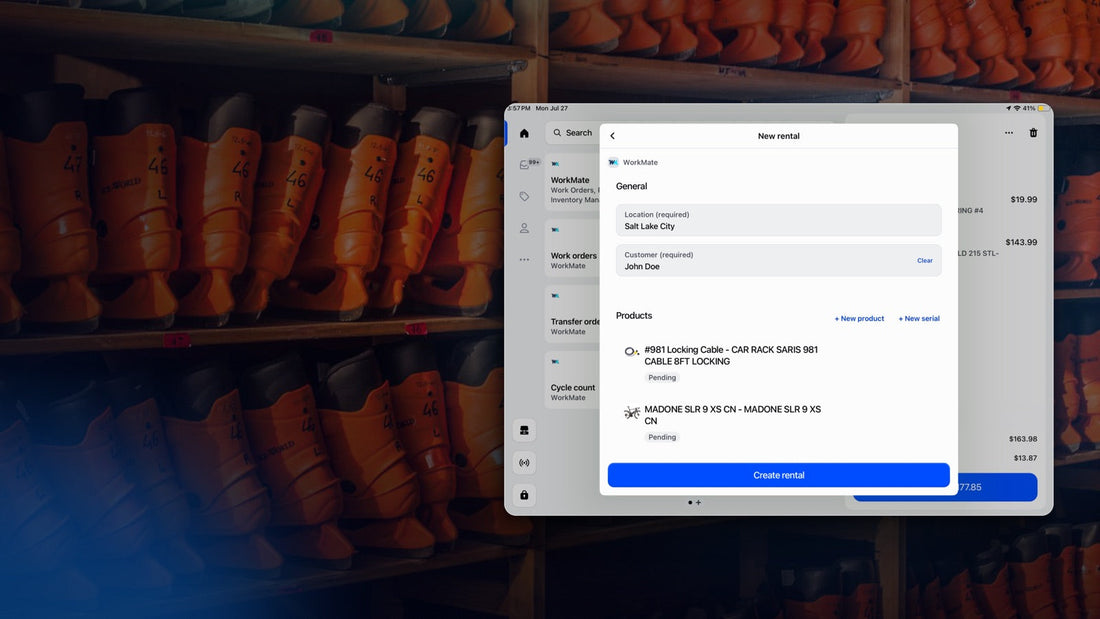

A retailer running several locations, a rental fleet and a service bench already knows what stock it holds. The harder question is about a single item: what shipment it arrived on, how many seasons it has been out, what the bench has done to it, and which store has it today. That is item history, and most retail systems do not keep it.
Rental and repair inventory works when one item has one record, from the day it arrives to the day it is sold. That record belongs in Shopify, extended to cover receiving, rentals and service work, so the fleet, the bench and the floor all work from it. Without that, the rental system, the workshop's job sheet and whatever the buyer keeps (a spreadsheet, or an ERP where there is one) each hold a different version, and answering one question about one pair of skis means checking all three.
Each of those started as a sensible fix. Rentals need out-and-return dates a retail system does not track on its own, a repair needs its own job number, and the buyer needs to know which stock came in on preseason terms. None of it was a mistake.
Putting one record under all three sounds like a large project, and on a closed platform it would be. On Shopify it is an extension rather than a rebuild, and that layer is what Teifi builds.
Bike shops run the same pattern with demo fleets and trade-in walls, as does any outdoor retailer renting hardgoods.
What a retail POS does well, and where it stops
Your point of sale closes the till each night and the numbers agree. It knows what sold, what it cost, who bought it and what is left on the shelf, which covers most of a retailer's week. Ask it what has happened to one pair of skis over two seasons and it cannot tell you, because it was built to record sales rather than to follow an item.
Most shops know this already. What stops them acting is timing: staff know the current system, the accountant has a routine built around it, and a migration in the wrong quarter puts a season at risk.
Winter Park Cycles came off two disconnected Lightspeed systems with, in its own account, no audit trail for custom builds, repairs or long-lead special orders. The sale was never the problem. The history was. Owner Ward Bates, now running on WorkMate, put it plainly: "Shopify does the front end very well. WorkMate fills that middle role, the hands-on workhorse, and then if you can push it to your accounting system, you're done."
We wrote about that shift in why bike shops are leaving Lightspeed for Shopify POS.
How do you track serial numbers in Shopify POS?
WorkMate assigns the serial on the purchase order as stock is booked in, inside Shopify POS. From then on the item can be found by its serial rather than by its model, and everything recorded about it afterwards, work orders included, attaches to that serial rather than to a date or a customer.

Without that step the serial only exists on the packing list. A pair of skis ordered from your distributor in September arrives, goes onto the showroom floor and the website, and when it comes back in January with a delaminated edge, working out which pair it is starts with a walk to the rack.
Preseason and at-once stock land in the same rack looking identical, and your buyer needs to tell them apart when next season's order goes in. Held in a spreadsheet, that knowledge leaves with whoever built the spreadsheet. Recorded on the purchase order, it stays with the stock.
How do you manage rental inventory in Shopify POS?
Teifi RMS carries rentals inside Shopify POS: check-out, check-in, availability, and stock adjusting as items go out and come back. The fleet and the floor draw down one count, so a pair that is out on rental cannot be sold on the website, and there is nothing to reconcile on Monday morning.

Rental usually sits outside the till, because out-and-return dates, durations and who is holding the item are not things a point of sale records. The fleet ends up in its own application, a spreadsheet, or an ERP module.
The rental system has the skis out until Sunday. The website still shows one in stock, so the order that arrives on Saturday has to be cancelled and refunded.
Across locations, a fleet item at your second store is visible from your first, so you rent what you have rather than what you can see.
Demo pairs eventually go on sale, and they go against the same inventory and customer record as the rest of your stock. The customer who skied on them on Saturday can buy them at the counter with nothing re-keyed, and the item's service record goes with the sale, which is what tells you the price to ask.
What does a warranty claim need from your records?
Proof of purchase and a legible serial, plus what the bench has done to the item since. WorkMate keeps the work order on the item, so the labor, the parts consumed and the technician who did the job attach to the serial, and the claim goes to the brand with a date, a serial and a service record.

The brands publish what they require. K2, to take one example, cannot process a claim without proof of purchase, and voids the warranty on bindings where the serial has been altered or removed.
Bench work usually gets filed against the day it was done or the customer who brought it in. That tells you what the workshop did last Tuesday. It doesn't tell you what work the skis have had.
Claims you can evidence get paid, and the hours spent assembling that evidence stop coming out of your own margin. A pair sold at your first store and brought back to your second is the same record either way.
Car Toys runs this pattern at scale in car audio and installation. Shelly Fuller, its Director of Operations, describes a business where "each customer's installation and parts package is unique", and its Shopify build added online appointment booking on the same platform the stores sell from.
The repair workflow itself, technician scheduling and split deposits included, is covered in the Service Retail Accelerator.
How do you keep stock accurate across several stores?
With transfers that create a record rather than send a message. Teifi RMS handles store-to-store transfers with an approval step and a receipt at the far end, alongside receiving against purchase orders, cycle counts and vendor records, so availability by location is something you can report rather than phone for.

A customer at your first store wants a pair your second store has. Someone phones across, someone checks a rack, and the pair is either transferred or the sale is lost.
Two people are now receiving. Stock moves between them without a receipt at the far end, and by spring each store's count disagrees with the system. What went missing in a mislogged transfer gets written off as shrink.
Valhalla Pure Outfitters runs 14 outdoor locations as a franchise out of Vernon, British Columbia. Its point-of-sale system aggregates inventory across every location and routes each online order to the right franchise partner on inventory and fairness rules.
That logic was why it stayed on an aging platform for years. Moving was conditional on keeping it, so we built around it and replaced the platform underneath.
Where those records have to agree with your accounting package or an ERP, Teifi Bridge keeps both sides in step, so the ledger and the floor agree.
How do you price ex-rental stock for resale?
Price it from the item's own record: the seasons it spent on the fleet, the work the bench has done and the parts replaced. ReSelly runs the intake, the listing and the consignor payout, so the resale sits on the same system as the history behind it.
Two pairs of the same model can be worth different numbers and look identical on the shelf. A pair that came off the fleet after two seasons and a base grind should not carry the price of one that did three seasons and never went near the bench, and pricing from the record is what stops a shop discounting its good stock and holding onto its tired stock.
Questions retailers ask
What does it cost to run rental and retail stock in two systems?
The visible cost is overselling and the time spent reconciling. The larger one is that neither system can answer a question about a specific item, so warranty claims, resale pricing and the year-end count all turn into manual work, and they land in the same few weeks.
Do you have to replace your ERP or POS to put item history in one place?
No. Valhalla Pure Outfitters kept the point-of-sale system that runs its franchise inventory allocation and moved the storefront to Shopify around it. Where an ERP or accounting package has to stay, Teifi Bridge keeps both sides in step.
How long does a multi-store move to Shopify POS take?
Published examples vary with scope. Winter Park Cycles moved a single location with service operations in seven weeks. Car Toys ran a 30-day first phase off Magento, with the full platform launch at five months.
What one record changes
A single pair of skis goes from the distributor's truck to the used rack. What costs money along the way is the systems around it disagreeing about what it is.
If you already put serials on at goods-in and carry them through the bench and the fleet, you have this, and there is nothing here to buy. If you do not, the work is one record, held in Shopify and extended to cover receiving, rentals and service. That is the Retail Commerce Suite, built across more than 50 retail implementations.