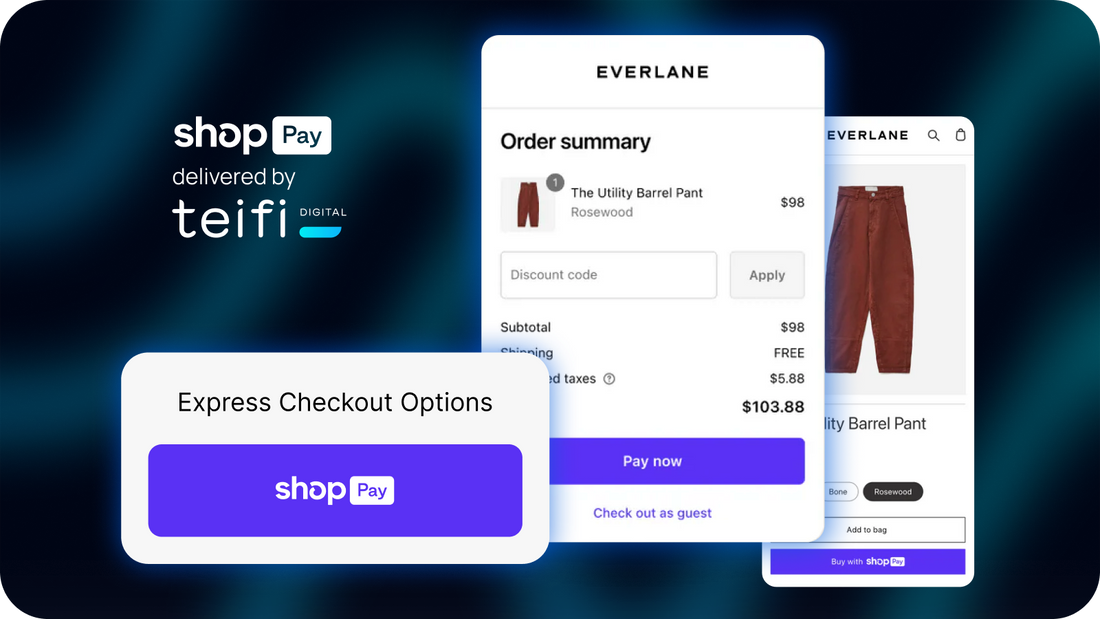

Shop Pay converts better than any other accelerated checkout, and brands can implement it even if they are not on Shopify. With Shop Pay Commerce Component, a custom or legacy checkout can add the Shop Pay button, recognize shoppers in the Shop Pay network, and let them complete purchases with saved payment and shipping details.
That matters in two ways. First, Shop Pay is a conversion acceleration tool: it reduces checkout work at the moment abandonment risk is highest. Second, it is an identity network and acquisition tool: it gives off-Shopify brands access to shoppers who already know Shop Pay, already trust the flow, and already have payment and shipping details saved.
Which accelerated checkout converts best?
Shop Pay. A study completed with a global management consulting firm in April 2023 found Shop Pay converts up to 50% higher than guest checkout and at least 10% better than every other accelerated wallet. It also runs four times faster than a guest checkout.
The lift is not only in conversion. Shopify's 2026 figures put average order value about 16% higher on Shop Pay. Behind that sits a network of 250M+ shoppers across 24 countries with payment and shipping details already saved, who Shopify reports are 77% more likely to buy again.
What happens to your other express checkouts when you add Shop Pay?
Adding Shop Pay does not replace your other express checkout options. In Everlane's self-built checkout, other express payment methods held steady after Shop Pay went live. What fell was manual credit card entry.
Your express wallets serve the buyer who has that wallet configured and reaches for it. Everyone else types. Baymard's review of 50 studies puts average documented cart abandonment at 70.22%, and among the reasons buyers give are a lengthy checkout process and reluctance to hand over card details. Both problems get worse when the site treats the shopper like a stranger.
Why does one-click checkout increase conversion?
The point of recognition is not just speed. It changes how much work the buyer has to do, and that can change what they do next. Cornell research published in Management Science tracked customers for 15 months after they adopted one-click buying and found they increased spending by 28.5%, raised purchase frequency by 43%, and bought 36% more items.
Shop Pay gets close to that one-click state without asking the buyer to create another account with your brand first. A shopper enters an email address, authenticates, and their shipping address and payment method populate. They select Pay now. It also works on people who never press the button: Shopify reports that displaying Shop Pay lifts lower-funnel conversion about 5% among buyers who check out another way.
Can you run Shop Pay without being on Shopify?
Yes. Shop Pay is available as a component that drops into your existing checkout, so brands on custom and legacy platforms can take the conversion benefit before any replatform. Everlane ran it on their own self-built platform and reached 15% of US transactions through Shop Pay within 30 days, at record high checkout conversion. FragranceNet, also on a custom platform, reported a 3.4% conversion increase and 7.5% growth in new customer acquisition with every existing function intact, in Shopify's Shop Pay Component Guide.
Three requirements shape the scope. Your checkout has to collect the customer's email before payment, your business has to be eligible for Shopify Payments, and the integration is engineering work against Shopify's APIs rather than a plugin install. Tax calculation stays in your system, which keeps recalculating whenever the address, delivery, discount or cart changes.
Where Teifi comes in
Shop Pay Commerce Component on your existing checkout. Teifi implements Shop Pay Commerce Component on your current checkout with no integration fee until you are live. Your checkout stays yours; Shop Pay runs inside it.
A lower-risk first step. For brands on custom and legacy platforms, Shop Pay can be the first measurable win in a broader commerce transformation journey: faster checkout now, clearer modernization path next. You do not have to decide on a full replatform before you prove whether recognized Shop Pay shoppers convert better on your site.
Implementation against your current stack. We build the drop-in script, server-side session calls, payment flow, order handoff and production fallback paths against the platform you already run.
Checkout compatibility. We map how Shop Pay fits into your existing tax, discount, delivery and order logic before implementation starts. Your platform continues to own the rules it already owns, while Shop Pay handles the accelerated payment experience for recognized shoppers.
Shopify Payments and reconciliation. Captures, refunds, cancellations and disputes have to reconcile against your order system. We wire those flows to Shopify's Admin API and build the reconciliation job behind the order webhooks, which is where these integrations usually fail.
Commerce transformation support. Once Shop Pay is live, we help teams decide what should stay in the current stack, what should move toward Shopify, and which parts of the commerce journey need modernization next.
Measurement after launch. We define the checkout baseline before release, then track Shop Pay usage, conversion lift, manual card-entry reduction and new-customer impact once it is live.
For brands not ready to replatform, Shop Pay gives the first measurable win: a faster checkout for recognized shoppers, added to the platform you already run.
This is Shopify engineering, but it does not have to start with a replatform.
Common questions
Do you have to be on Shopify to use Shop Pay?
No. It runs as a component inside an existing checkout on custom and legacy platforms.
Does Shop Pay require Shopify Payments?
Yes. Eligibility for Shopify Payments is a condition of using Shop Pay, on or off Shopify.
Will it replace Apple Pay, Google Pay or PayPal?
No. Shop Pay sits alongside other express checkout options and reduces manual card entry.
Who handles tax and refunds when Shop Pay runs on another platform?
You do. Tax calculation stays in your system, and captures, refunds and disputes run through your own order flows against Shopify's APIs.
What does Shop Pay add beyond another payment button?
It adds access to the Shop Pay identity network at checkout: shoppers with saved payment and shipping details can move through faster, which reduces manual entry and checkout friction.
What does "no integration fee until live" mean?
It means Teifi scopes and implements the Shop Pay Commerce Component against your current checkout, with the first commercial milestone tied to a working production launch.
If you are reading these conversion numbers from a custom or legacy platform, the next step is not a replatform plan. It is a Shop Pay implementation scope: what has to connect, what has to reconcile, what launches first and what lift you can prove once it is live.