
Seven weeks. That is how long Winter Park Cycles took to leave Lightspeed, move 15,000 SKUs and the service counter onto Shopify POS, and start selling. In the first 90 days it recorded $600,000 across nearly 1,000 orders, zero chargebacks and a record sales month. Four people now sell 70 to 80% of monthly sales online in peak season.
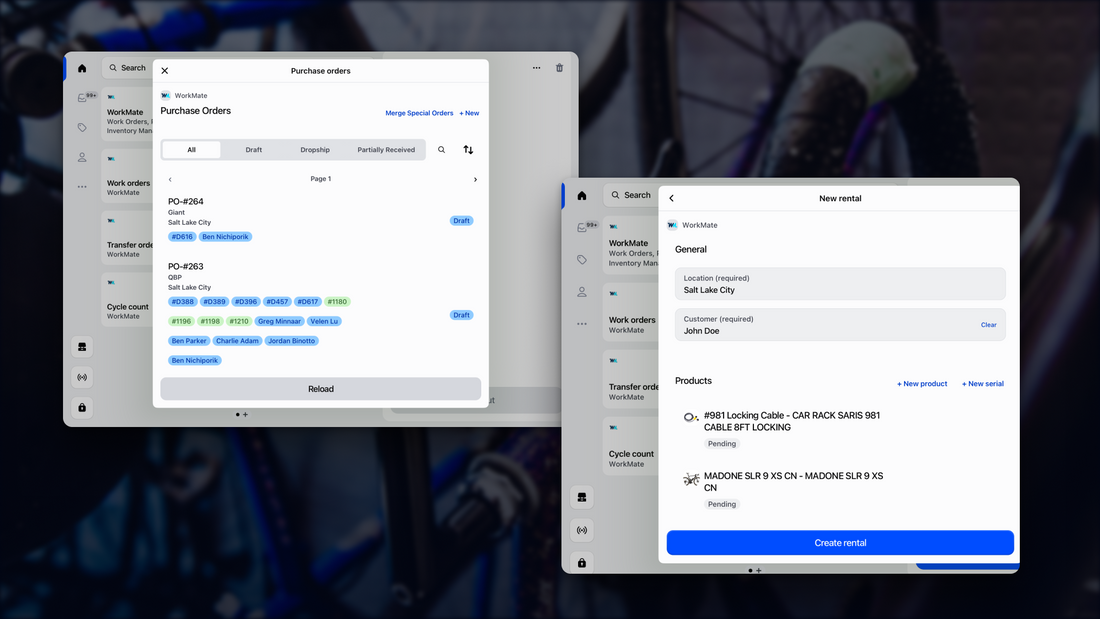
Visibility comes first. Weighted average cost recalculates as stock is received, every job on the bench is a Shopify order carrying its own labor and parts, and serials follow the bikes the shop owns.
Then innovation. Shopify spent $1.5 billion on research and development in 2025. Lightspeed spent $126 million in its year to March 2026, on total revenue of $1.227 billion, shared across hospitality and eleven other retail categories. Twelve dollars to one, and bike gets a fraction of the smaller number.
Extensibility is the next difference, and it is where the shop stops adapting itself to the software. WorkMate runs the service counter inside Shopify POS, so work orders, serials, special orders and rentals are Shopify orders. Bookkeep carries the accounting. Teifi Bridge keeps a supplier feed or an ERP in step. A closed product has one roadmap and one owner: when Lightspeed bought Vend in 2021, Vend's retailers were moved onto Lightspeed Retail, and nobody asked users which parts they wanted to keep.
Then cost of ownership. On Shopify, payments, service software and accounting are separate lines, each renegotiated on its own. Lightspeed's own service agreement renews automatically at the then-current price, states that a discount agreed at signing does not carry into the renewal, and charges a monthly fee to any merchant processing cards anywhere else. Most of the cost is labor anyway: at 41% of revenue, the hours a system eats are what it really costs.
Visibility on Shopify POS: cost, labor, and every bike you own
In Teifi's migration work, shops arriving off Lightspeed ask for the same things first: serialization with warranty lookup, work order history against the bike, and special orders that reach the supplier.
What you paid. Bike sales have barely broken even for a decade once overhead is counted (NBDA figures via Bicycle Retailer). So the cost on the screen has to be right. WorkMate recalculates weighted average cost every time stock is received. A supplier invoice above the order price is flagged on arrival, and anything over 10% is marked high.
What the bench earned. The NBDA recommends planning a 60% gross margin on service work. That target is guesswork if the numbers arrive weeks later as one total. WorkMate logs every repair, build, rental and custom job as a Shopify order with an assignee and a due date. Labor bills at a fixed price or by the hour, and parts are tied to the job that consumes them. Deposits, balances and full payment are taken in Shopify POS. Throughput, revenue and turnaround report next to Shopify's own analytics, so the shop can read the bench without waiting for month end.
What you own. A shop cannot price a used bike, or honor a warranty on it, without knowing which unit it is. WorkMate captures serials in the serials module or as a purchase order is received, then attaches them to the order the bike leaves on, so the shop knows which unit went to which customer. Rentals go out against specific products or serials, with Shopify inventory restored on return. Service stock and sale stock sit in one Shopify inventory.
What the supplier owes you. A part the shop does not stock is raised as a special order that carries the number of the job waiting on it, then merges into the purchase order that fills it. Supplier minimums and re-orders run in the same place. Vendor catalogs feed in through partnered integrations with Giant, Trek, Specialized, Santa Cruz, HLC and QBP, and customers are notified when a job is received, ready or waiting.
What the platform gives you before you add anything. Shopify POS Pro reports sales by staff member, location, time period or customer, compiles a daily sales report, and tracks inventory in real time across the counter and the online store. That is day one, on a stack the shop can add to whenever it needs to.
Innovation: 150+ updates in six months, and a minute back at the counter
Those views keep improving without the shop asking. Shopify packages what it ships every six months. The Spring 2026 edition, published on June 17, carried 150+ updates. The one a bike shop feels is POS v11, a rebuilt checkout that Shopify says saves retail staff "over a minute on complex cart builds". A bike, two accessories and a labor line is a complex cart. The same edition brought the Verifone Victa mobile, which scans barcodes, takes card payments and doubles as a countertop terminal.
Between editions the work lands continuously. In the last week of July 2026 the developer changelog recorded direct printing to hardware receipt printers from POS and new fields for cash drawers. Nobody at a bike shop filed a ticket for either.
Bike-specific work reaches the same platform from specialists. WorkMate is built for shops with a service counter, and its bike build carries vendor catalogs from Giant, Trek, Specialized, Santa Cruz, HLC and QBP. On Lightspeed, bike is one of twelve retail categories inside a single product.
The shop runs neither roadmap.
Total cost of ownership: $69 bundled, or $560 to keep your own processor
None of which costs what a bundle costs. In May 2023, Lightspeed gave retailers thirty days to move onto Lightspeed Payments or pay more to keep the processor they already used. New customers were not offered the choice. Kitty Monsalud of Bike Attack in Southern California ran her own numbers for Bicycle Retailer: $69 a month on the bundled plan, against roughly $560 to keep her processor, made up of her $136 subscription plus transaction fees. She called it "blackmail."
That is one line on one invoice. Hours are the bigger line. Winter Park had Lightspeed posting daily sales, cost of goods sold and purchase orders into QuickBooks, and losing that would have meant hours of manual accounting every week, so it was rebuilt through Bookkeep before cutover. Parts tied to the job that consumes them stop leaving the shop unbilled.
The rest of the saving arrives later, when the business changes. A second location, a wholesale line, a supplier feed, an ERP: on Shopify each of those is an addition, not a migration. Shopify tracks inventory across locations, WorkMate runs the service counter, Bookkeep carries the accounting, and Teifi Bridge keeps an ERP or supplier system in step. Any one of them can be replaced without touching the others. The shop changes a line, not a platform.
One channel: one catalog, one price, four people
The same catalog puts the shop online. Before the move, Winter Park pushed product feeds through third-party connectors that owner Ward Bates calls "conduits", and the price in an ad was never reliably the price on the floor. On Shopify a product is created once and the price is live at the counter and online the moment it is set. "When we launch a sale today, our prices update and hit Google almost immediately and then we start seeing sales come in," Bates says. "If we drop a price low enough, we'll sell it that day."
That is how four people keep up with the volume above.
On Lightspeed, the point of sale and the online store are two products, bought separately.
Records: listed, checked, and rebuilt before cutover
All of it depends on the records arriving intact. Shopify's bike-shop offer includes setup help to get a shop trading. Historical records are where an implementation partner picks up, and Teifi scopes them first.
Teifi lists purchase history, service history and serial numbers in an agreed format before anything moves, then checks them on arrival rather than finding them missing mid-season. The weekly reports, the accounting automation and the special-order chain are rebuilt before cutover, so the shop opens Monday doing what it did Friday.
Shops are right to ask. Staci May of Earl's Bike Shop told Bicycle Retailer she was hesitant "because of the probability of losing information we have gathered over our 15-year history on the same system." Her caution is well founded. Lightspeed's own upgrade documentation warns that even moving between its own ecommerce products leaves historical data such as invoices, subtotals, discounts and taxes behind.
That work has a price, and Bates put a number on it. He ran Winter Park's migration himself, on a background in web design and database management most shop owners do not have. "If I was doing it at my old design day rates, it was probably a $150,000 project from beginning to end," he says, counting design, data migration and integrations. "It would've been worth the cost even if I wasn't able to do it myself." He says the shop is on track to double sales inside a year, and calls that conservative. The build and the numbers are in the Winter Park Cycles case study.
Timing: when to move, and when to stay put
A shop with no online side to speak of, where the counter is the whole business, is unlikely to recover the cost of a migration. That shop should stay where it is.
For most shops it is a question of when: a renewal date, a quiet month, the end of a season. Teifi scopes the work against that date.
Talk to us about your migration
Questions shops ask before signing
What happens to my service history if I leave Lightspeed?
It comes with you, as long as somebody scopes it first. Customer and product records migrate as a matter of course. Service history is the piece that has to be listed before the move and checked after it. Shopify's own bike-shop setup offer excludes historical data migration, so agree who is doing it before you sign.
Can Shopify POS handle bike repairs, serial numbers and special orders?
Yes, through service software built for bike retail on top of Shopify POS. WorkMate logs repairs, builds and rentals as native Shopify orders with an assignee and a due date, prices labor at a fixed rate or by the hour, ties parts to the job, and runs special orders and purchase orders in the same place. Vendor catalogs feed in from Giant, Trek, Specialized, Santa Cruz, HLC and QBP.
What does my accounting look like after the move?
The daily sales, cost of goods sold and purchase order sync into QuickBooks can be rebuilt. Winter Park Cycles runs it through WorkMate into Bookkeep, with sales tax included in the daily journals.
How long does a Lightspeed to Shopify migration take?
Weeks rather than quarters when it is scoped properly. Winter Park Cycles went from concept to live in seven weeks, including 15,000 SKUs and the service counter.
What does a Lightspeed to Shopify migration cost?
It depends on how much history moves and how many integrations get rebuilt, so scope drives the number. For comparison, Winter Park's owner ran his own migration and put the work at $150,000 at professional design rates, counting design, data migration and integrations.