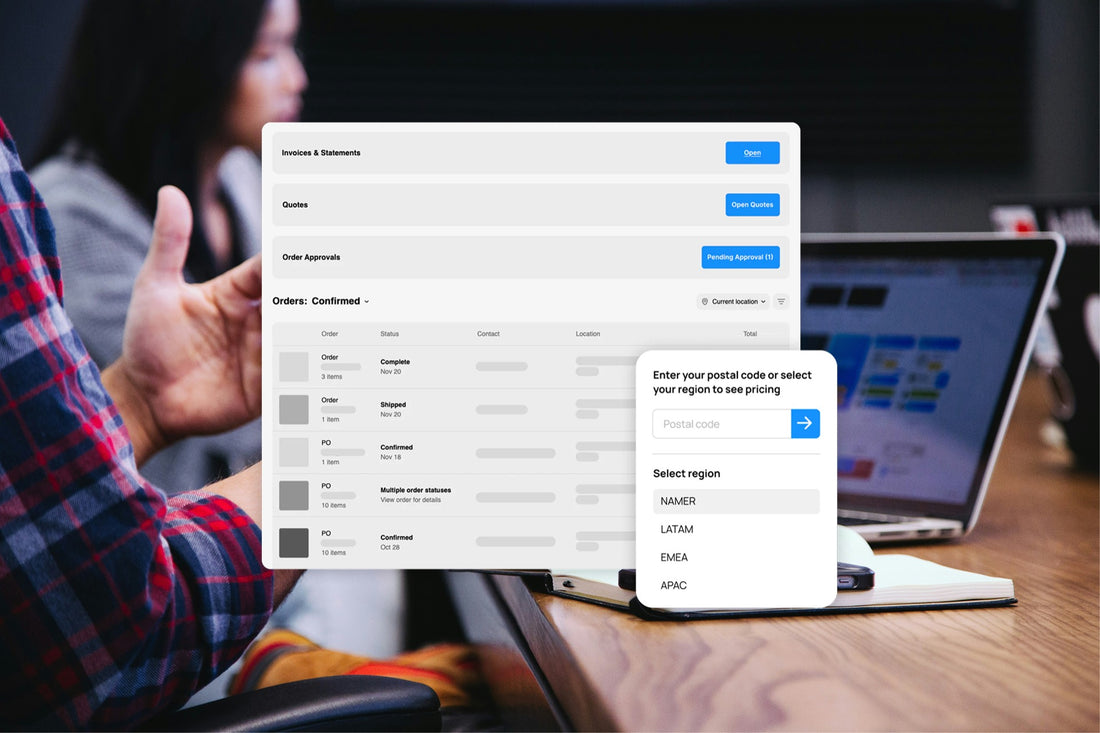

Most B2B companies do not run one commerce operation. They run several, stacked on top of each other and held together by manual work. A negotiated price list lives in a spreadsheet. The reorder portal pulls from one system, the sales rep quotes from another, and the warehouse counter runs on a third. Every channel tells the customer a slightly different story about price, availability, and order status, and someone in the back office spends their week reconciling the gaps. That gap is not a back-office nuisance. It caps online revenue, slows every quote, and teaches your largest buyers not to trust the price on the screen. And most of them now want that screen to do the selling: 67% of B2B buyers prefer to buy without talking to a rep (Gartner, March 2026). Closing those gaps is what unified B2B commerce is for.
The industry has a name for the fix, even if the term is overused. As Peter Tivy, Founder of Teifi Digital, put it in EY's Future Proofing Retail: Embracing Unified Commerce (November 2024, p.18):
"Businesses have chased omnichannel for years, but unified commerce is the end game."
This is the practical version of that idea for B2B: what the term actually means, where Shopify's native B2B reaches its edge, how to architect past it with Shopify as your Commerce Operating System, and what it looks like in production at a distributor running over 100,000 products. If your catalog runs into the tens of thousands of SKUs, your pricing is negotiated by account and volume, and an ERP still owns price and inventory, this is written for you.
What unified B2B commerce means, and why B2B raises the bar
Unified B2B commerce runs every buying motion (self-serve web, sales-assisted ordering, the reorder portal, and the counter) against a single data model on one platform, rather than stitching separate systems together after the fact.
You will also see this written as B2B unified commerce. It means the same thing.
The distinction from omnichannel matters because the two get used interchangeably. Omnichannel is the front-end experience: a buyer can move between channels and recognize your brand. Unified commerce is the architecture underneath: products, price lists, inventory, and orders consolidated into a single source of truth that every channel reads from and writes to. You can have a polished omnichannel experience sitting on a fragmented back end. That is the trap most B2B operations fall into.
B2B raises the bar because the data model is harder. Consumer commerce is mostly one buyer, one price, one cart. B2B adds layers that all have to resolve at once:
- Account hierarchies, where a parent company has dozens of locations, each with their own buyers and approval chains.
- Contract and negotiated pricing that varies by customer, by volume, and by product category at the same time.
- Volume breaks, payment terms, approval workflows, and punchout into buyers' procurement systems.
- Sales-assisted ordering, where a rep places the order on the buyer's behalf.
And in almost every case, an ERP remains the system of record for price and inventory, and that fact shapes everything that follows. None of this is optional; it is the operating reality.
The market rewards getting this right. Digital Commerce 360, analyzing U.S. Department of Commerce data (January 26, 2026), reported that U.S. manufacturing and wholesale distribution sales reached $15.12 trillion in 2025, with digital commerce growing at a double-digit pace even as overall B2B demand stayed flat. The buyers who want to self-serve are the ones still growing. If they cannot get an accurate price in under a second, they call a competitor.
Shopify native B2B: what it does out of the box, and where it reaches its edge
Start with the reassurance, because it is earned. Shopify built B2B into the core of the platform rather than bolting it on. Out of the box you get company profiles with multiple locations and buyers, up to three custom catalogs with tailored pricing, volume discounts and quantity rules, vaulted credit cards, and net payment terms. For a large share of B2B operations, that native foundation covers the requirement, and the honest answer to "do we need to build anything custom" is often no.
Native capability also has an edge, and this is the decision most teams get wrong - they either over-build on day one or discover the constraint after launch. Four edges are worth knowing before you commit.
The first is catalog count. Native Shopify supports up to three active pricing catalogs. Three buyer tiers, fine. Fifteen distinct contract tiers, and you need an architecture that resolves price per account rather than per catalog.
The second is the shape of the pricing logic. Native volume discounts are variant-specific: a buyer hits the threshold on a single variant rather than mixing variants to reach a volume break. For many catalogs that is correct. For distributors whose customers buy across a category to hit a tier, it falls short of the rule the business actually runs on.
The third is the source of truth. When price is negotiated per customer and lives in an ERP, the catalog is no longer the authority; the ERP is. Pricing that varies by customer, volume, and category at once, or rates synced live from an ERP, both call for pricing logic that resolves the right number at request time.
The fourth is scale. B2B catalogs can hold hundreds of thousands of SKUs with intricate relationships, and sub-second performance at that scale needs deliberate architecture rather than default configuration.
None of these are failures of the platform. They are the line between what the platform standardizes and what is genuinely specific to your business, and the job of an architecture is to extend Shopify precisely where your operating reality reaches past the defaults.
How to architect unified B2B commerce on Shopify
The principle is simple to state and disciplined to follow: extend, don't replace. Shopify is your Commerce Operating System - the system of record for the storefront, the B2B buyer experience, the cart, and the order. You do not re-platform your enterprise stack onto it. You connect that stack to it and let each system keep the job it is good at.
Where native B2B reaches its edge - complex pricing, large catalogs, multi-region and multi-ERP sync - you extend Shopify through Teifi Bridge, the extensibility platform that connects Shopify's single data model to your enterprise systems. It is event-driven. It watches Shopify webhooks for order, customer, and inventory events, transforms each payload to match the shape the receiving system expects, then reconciles the transfer so the records stay in agreement. Bridge is not a passive pipe; the detail on the connector layer, including how it compares to a general iPaaS approach, lives in the Teifi Bridge blog rather than here. Where tax applies, the pattern connects to a tax engine such as Vertex; the engine computes the tax, the architecture routes the call.
With the model settled, run the rollout as a sequence, not a single launch. We call it the Extend-First Rollout: six steps, ordered to protect revenue and avoid downtime.
- Confirm the native B2B features are live and configured. Turn on company profiles, catalogs, payment terms, and quantity rules before building anything custom. Most teams under-use what is already there.
- Map buyer groups and the company hierarchy. Model parent accounts, locations, buyers, and approval chains to mirror how purchasing actually works, before any catalog is built on top of them.
- Build catalogs to replace the spreadsheets. Move negotiated price lists out of email and into structured catalogs so price stops being a manual lookup.
- Wire the ERP and the source-of-truth pricing. For standard back-office sync, Shopify's Global ERP Program offers certified connectors for systems like NetSuite and Microsoft Dynamics 365 Business Central. Where the integration runs deeper - live price resolution, multi-system reconciliation - connect the ERP through Teifi Bridge so price and inventory resolve in real time from the system that owns them.
- Prioritize the self-serve reorder flows. The reorder and quote motions carry the most volume and the most friction; ship them first so the rep-free buyers Gartner identified can serve themselves.
- Launch a new site first, then migrate the flagship. Stand up a lower-risk storefront to validate the architecture in production, then migrate the primary storefront once the pattern is proven. Switching everything over in one go is where data loss and downtime live.
Proof in production: Guillevin
Guillevin grew online sales by 36% and improved conversion rate by 69% after rebuilding their B2B operation on Shopify.
Guillevin is one of Canada's largest electrical distributors, with 100+ locations nationwide, more than 100,000 products, and billions of price combinations. That scale is exactly the operating reality the edges above describe, and before the rebuild it carried a real cost. The legacy stack took 7+ seconds to load a pricing page and pulled 34,000 client records from the ERP on every single visit. Seven seconds is not a slow page; it is an abandoned cart and a phone call to a competitor. Doing nothing had a price, and Guillevin was paying it on every visit.
The rebuild applied the extend-don't-replace pattern. Shopify became the commerce core and buyer experience; Bridge connected five enterprise systems so price and inventory resolved from the systems that own them: P21 for ERP, InRiver for product information, Auth0 for identity, Coveo for search, and Jitterbit for integration. Those five are Guillevin's stack, not a fixed menu; the same pattern extends to whatever combination of ERP, PIM, identity, search, and integration systems a business already runs.
The result was sub-second pricing lookups for 100,000+ products across multiple regions, against a 7-second before-state. Beyond the headline growth and conversion numbers, the architecture now processes 10M+ webhooks weekly at 99.5% uptime, and the initial migration moved 3.2M orders and invoices (1.5M orders plus 1.7M invoices) in 28 hours with near-zero data loss. The platform has since handled 1,200+ online quotes. The full breakdown is in the Guillevin case study.
How to evaluate a Shopify unified B2B commerce partner
If you are choosing a partner to build this, the wrong filter is a wall of logos. The right filter is whether they have run your operating reality in production. Use these criteria as a category checklist.
Look for proven handling of company accounts and account hierarchies, not just a demo of a single buyer. Look for negotiated pricing that resolves by customer, volume, and category, and for approval workflows and sales-assisted ordering, because your reps will place orders on behalf of buyers. Look for clean, reconciled integration to the systems that own your data: ERP, PIM, OMS, CRM, 3PL, tax, and payments. And look for on-vertical production case studies with hard numbers attached, because a distributor's pricing problem is not a fashion brand's catalog problem, and the difference shows up only at scale.
"Two things make B2B work on Shopify, and only one of them tends to get attention early. Integration is the foundation. Pricing, inventory and contract terms have to resolve against the system of record, and nothing works until that's right. But that moves the data; it doesn't get a buyer through a large, complex order. That's where the nuance on the front end matters, and design can carry more scope than teams expect. I put both on the table early, so neither one arrives later as a change order."Jess Lancaster, Director of Enterprise Solutions
By that standard, Teifi is the leading Commerce Transformation Partner for Shopify, focused on Shopify's largest, most complex brands. The B2B Commerce Suite is the hub - not a bundle - for running complex B2B operations on the platform, with Teifi Bridge handling the ERP extensibility the checklist above calls for, and Guillevin is the production case that clears every item on the list. The deeper commercial detail lives on the B2B page.
Frequently asked questions
The questions buyers ask us most often, answered directly.
What is unified B2B commerce?
Unified B2B commerce runs every buying motion (self-serve web, sales-assisted ordering, the reorder portal, and the counter) against a single data model on one platform, so every channel reads from and writes to the same record of products, price lists, inventory, and orders.
Does Shopify support B2B?
Yes, natively. Company profiles with multiple locations and buyers, custom catalogs with tailored pricing, volume discounts and quantity rules, vaulted credit cards, and net payment terms all ship out of the box. For most operations that foundation is enough; at fifteen-plus contract tiers, ERP-owned pricing, or six-figure SKU counts, the move is to extend it, not replace it.
Can Shopify handle complex B2B pricing and large catalogs?
Yes, with deliberate architecture. Keep Shopify as the commerce core and extend it through an extensibility platform such as Teifi Bridge, so price resolves in real time from the system that owns it. Guillevin runs 100,000+ products and billions of price combinations with sub-second pricing lookups on this model.
What should I look for in a Shopify unified B2B commerce partner?
Evidence they have run your operating reality in production: account hierarchies, negotiated pricing that resolves by customer, volume, and category, sales-assisted ordering, reconciled integration to ERP, PIM, OMS, CRM, 3PL, tax, and payments, and on-vertical case studies with hard numbers attached. The evaluation checklist above is the full filter.
Conclusion
Unified B2B commerce is not a re-platforming project and it is not a feature you switch on. It is a single data model that every buying motion reads from, with Shopify as the Commerce Operating System and your enterprise systems extended into it where native capability reaches its edge. Extend, don't replace. Guillevin proves the pattern holds at over 100,000 products and billions of price combinations.
If your B2B stack is leaking revenue through slow pricing, manual reconciliation, or a reorder flow buyers avoid, you do not have to replace Shopify to close the gaps. The next step is to map your architecture against this blueprint with a team that has built it in production.