
For automotive businesses running on Adobe Commerce, SAP Hybris, Salesforce Commerce Cloud, Oracle ATG, or OroCommerce, the question isn't whether Shopify can handle the complexity. Parts 1 and 2 of this series laid out how - fitment as structural data, unified buyer types on one platform, ERP/PIM/ecosystem tools connected rather than replaced.
The question most automotive leaders ask next isn't about capability. It's about risk.
Can the fitment data survive the transition?
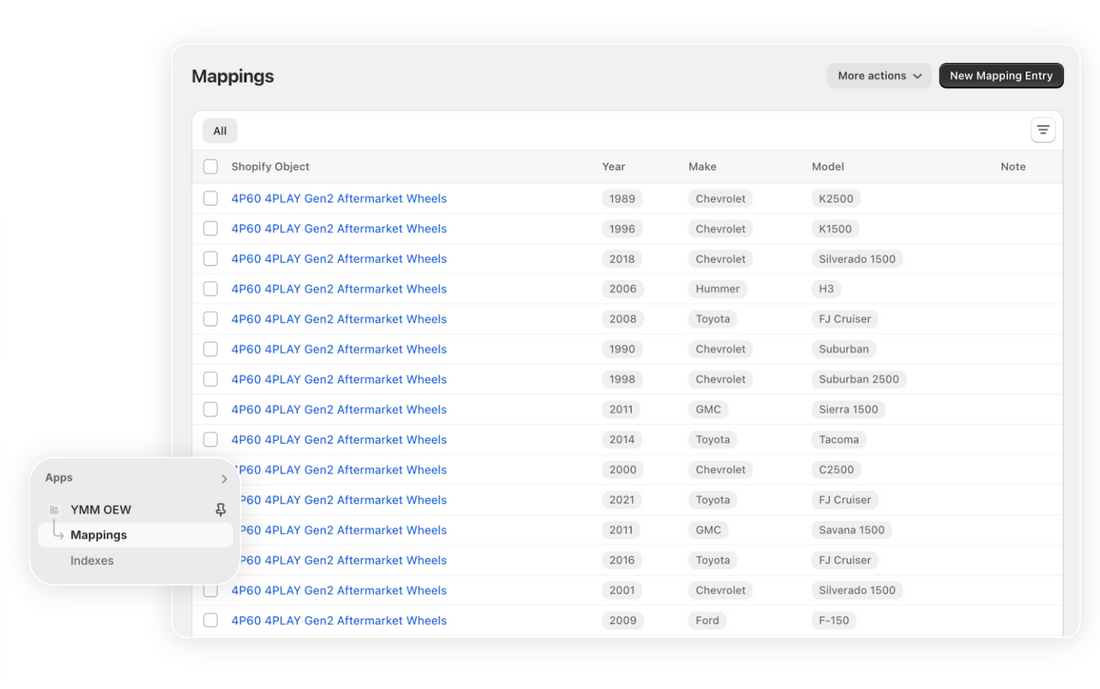
It's a valid concern. YMM mappings built over years, across hundreds of vendor relationships, represent irreplaceable institutional knowledge. If those mappings don't come across intact, the new platform starts broken. Zero-result pages appear on high-intent searches. Wrong-part returns spike. The business spends its first quarter on the new architecture reconciling data instead of running commerce.
That failure pattern is the reason most automotive migrations treat the storefront as the priority and the fitment layer as a reconciliation project afterwards. It's also why most of them struggle.
The businesses that migrate cleanly do it the other way around.
Why the Data Moves First
The storefront is the most visible layer of a commerce architecture. It's also the easiest to rebuild. Themes, templates, PLPs, PDPs, checkout flows - these are well-understood commerce patterns. A migration team can build them in weeks.
Fitment data is neither visible nor easy. It's a decade of vendor relationships, ACES/PIES normalization decisions, exception handling for vendor conflicts, and institutional knowledge about which mappings the business trusts. You can't rebuild it in weeks. You can only move it - and if you move it after the storefront is already live, every fitment inaccuracy surfaces as a customer-facing failure.
Fitment-first means the storefront migrates against a verified fitment foundation, not a fitment layer being reconciled under a live storefront. The storefront is built last because everything it does - vehicle selection, PDP confirmation, search relevance, cross-sell logic - depends on fitment data that's already indexed and accurate.
The Fitment-First Migration Sequence
Five stages, run in this order.
1. Data state audit. What fitment data exists, where it lives, how it's structured, what gaps and conflicts are present across vendor feeds and legacy systems. This is the stage that tells you whether the migration is a two-month project or a six-month project. Skipping it is how timelines blow up in month three.
2. ACES/PIES normalization and validation. Fitment records consolidated into unified YMM mappings. Direct-fit and universal-fit data reconciled. Vendor conflicts flagged and resolved before import. The fitment layer gets built and validated against legacy data before it touches Shopify.
3. Fitment indexing. Validated data loaded into Teifi Parts with incremental reindexing configured. The fitment layer is live and queryable - but not yet visible to customers because there's no storefront pointing at it.
4. Commerce and integration build. Storefront, ERP sync, PIM connection, buyer-type workflows - all built against the verified fitment foundation. Every feature that depends on fitment (vehicle selector, Fits/Doesn't Fit confirmation, fitment-aware search) operates against real, validated data from day one of development.
5. Unified go-live. Every buyer type, every integration, every fitment record live together. There's no "fitment phase two" after launch. There's no customer-visible reconciliation. The architecture is unified from the moment it's live.
The pattern matters because the alternative - migrating the storefront first and reconciling fitment afterwards - guarantees that customers experience fitment errors during the reconciliation period. And in automotive, customer-visible fitment errors erode trust faster than they erode conversion.
Two Migrations, Two Starting Points
OE Wheels - dual Oracle SuiteCommerce to a single Shopify architecture in under 6 months. The largest distributor of replica wheels in the United States, with fitment requirements that go beyond YMM - bolt pattern, offset, hub bore, load rating, each of which can trigger a safety issue if wrong. 250,000+ lines of fitment data imported via Teifi Parts. Wholesale and retail operations consolidated onto one backend.
"They were able to give us all the features and functionality that we really needed to create a better shopping experience for our customers." - Chris Diaz, Operations Manager, OE Wheels
Read the full OE Wheels case study →
Royal Distributing - proprietary fitment engine and PIM unified with Shopify across 1M+ SKUs and 700+ vendor relationships. Canada's largest powersports distributor, with decades of powersports compatibility knowledge that couldn't be replaced and couldn't be left behind. Teifi's architecture connected Royal's existing fitment engine rather than rebuilding it - wholesale, DTC, and physical retail unified for the first time.
Read the full Royal Distributing case study →
Two different starting architectures, two different fitment data structures, two different vendor ecosystems. Same migration pattern. Same unified architecture at the finish line.
What Is the Current Architecture Actually Costing?
The architecture works. The migration path is proven. Which means for businesses still running on Adobe Commerce, SAP Hybris, Oracle ATG, BigCommerce, or custom .NET and Java stacks, the remaining question isn't capability. It's what the current architecture is actually costing.
Legacy enterprise platforms carry compounding overhead: platform licensing that doesn't scale proportionally with revenue growth, bespoke connector maintenance that consumes engineering cycles with every ERP or PIM change, and fitment logic that requires permanent operational attention to stay accurate. The SME bottleneck - the two or three people who understand how the connectors work - creates a ceiling on how fast the catalog can grow and how fast the team can move. That overhead doesn't shrink as the business grows. It grows with it.
Consolidating on Shopify with Teifi removes the middleware layer. Platform licensing overhead drops. The connector maintenance cycle ends. Engineering capacity shifts from keeping infrastructure running to improving commerce. Every buyer type operates from a single architecture - one fitment layer, one pricing model, one integration surface - without duplicating the operational model beneath each.
The revenue case closes itself. Accurate fitment converts. Fitment-aware cross-sell grows AOV. Zero-result pages stop leaking revenue that never appears on a dashboard. Wrong-part returns stop eroding margin - and stop eroding the customer trust that drives repeat purchase in automotive commerce.
Both arguments point to the same architecture.
Ready to Map Your Migration Path?
A migration isn't a rebuild. It's a redirection - moving the institutional knowledge that makes your business work onto a foundation that lets it scale without the overhead that's been holding it back.
Teifi's Fitment Architecture Assessment covers migration scoping: what data needs to come across, what breaks if it doesn't, and what a realistic timeline looks like for a business at your scale.
Book your Fitment Architecture Assessment →
Other posts in this series:
Part 1 — Shopify for Automotive: One Architecture, Every Buyer Type. Why unified commerce for automotive is an architecture problem, not a platform problem.
Part 2 — Inside the Fitment Layer: How Teifi Parts Handles YMM at Enterprise Scale.
The technical deep-dive on fitment infrastructure, indexing, ecosystem amplification, and Royal Distributing in production.