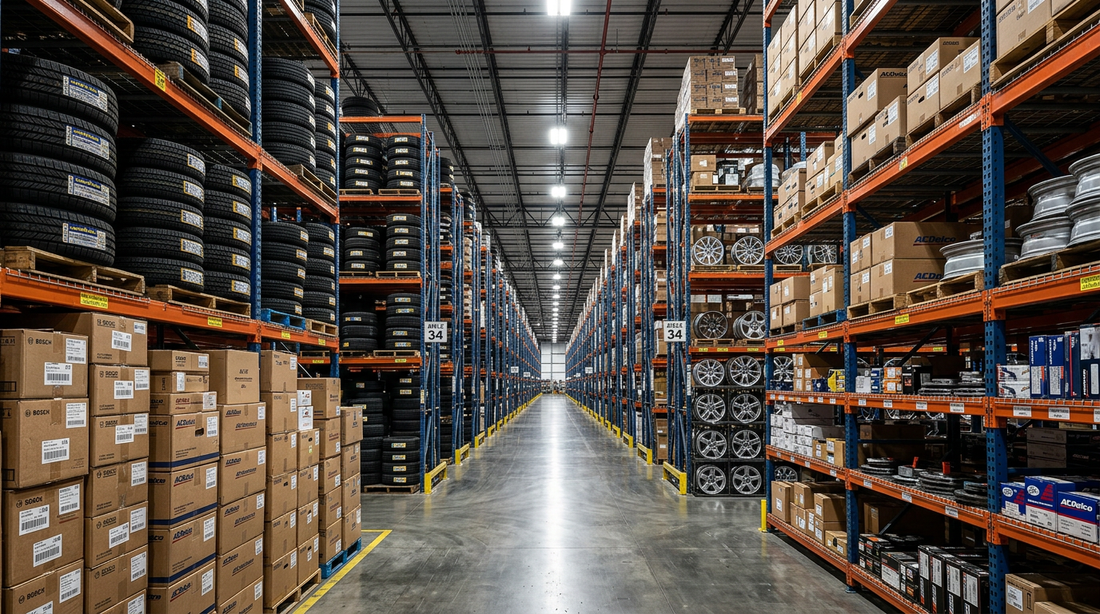

A wrong compatibility confirmation is a return, a warranty call, a support cost. For automotive businesses ingesting ACES/PIES feeds from hundreds of vendors, managing fitment data down to engine trim level across hundreds of thousands of SKUs - that failure isn't isolated. At 500K+ SKUs it's a systems problem with direct P&L impact.
That problem touches every corner of the automotive world. Aftermarket parts distributors managing millions of SKUs across hundreds of vendors. Dealership networks running wholesale, retail, and service from disconnected systems. Aftermarket brands scaling from a single product line to a full catalog. Service networks that need real-time parts availability and vehicle-accurate ordering. The specifics vary. The underlying architecture challenge is the same: how do you run unified commerce - wholesale, DTC, and POS on one platform - with Year-Make-Model fitment accuracy built into the data model, not bolted on top of it?
That's the question Shopify is now answering for the automotive industry. And the architecture that makes it work at enterprise scale is what Teifi Digital builds on top of it.
The Problem Isn't Complexity. It's Where Complexity Lives.
Automotive commerce is genuinely hard. Catalogs with compatibility requirements down to engine trim level. ACES/PIES vendor feeds that arrive inconsistently - with gaps, conflicts, and format variations across hundreds of suppliers. Buyer audiences that span retail consumers, wholesale accounts, dealership networks, and service operations - each with different pricing, workflows, and purchasing logic. ERP systems that are the authoritative source for pricing, inventory, and ATP - but that don't speak natively to any commerce layer.
The result for most automotive businesses is a stack with multiple versions of truth. Fitment data managed in one system. Pricing in another. Inventory somewhere else. Search operating on a stale export. When any of these fall out of sync - a vendor feed update, a PIM restructure, an ERP pricing change - buyers see wrong compatibility confirmations, or worse, they see nothing at all.
Zero-result pages are the most invisible form of lost revenue in parts commerce. A buyer who selects their vehicle, enters a search, and gets zero results doesn't raise a support ticket. They leave. The conversion loss is real, but it never appears as a line item in your analytics - it disappears into exit rates and bounce data that looks like normal traffic behaviour.
The platforms most automotive businesses are running today - Adobe Commerce, SAP Hybris, Salesforce Commerce Cloud, Oracle ATG, OroCommerce - weren't designed around fitment. They handle general-purpose enterprise commerce, and they handle automotive through custom development: ACES/PIES connectors bolted onto data models that don't understand YMM, fitment overlays patched on top of search, separate integrations for each buyer type that all need to stay in sync with the same ERP.
The result isn't a bad platform. It's a brittle architecture. And the team maintaining it isn't running commerce - it's running infrastructure.
Three Places Fitment Breaks
Across the automotive businesses we work with - distributors, aftermarket brands, dealership networks, service operations - fitment failures follow the same patterns.
Outside the data model. When fitment logic lives in a connector layer rather than the core data model, it drifts. An ERP pricing update, a PIM restructure, a new vendor feed - any of these can push the fitment layer out of sync with the commerce layer. Buyers get wrong compatibility confirmation. Returns follow.
At catalog scale. Most search implementations perform acceptably below 100,000 SKUs. Above 500,000, query response degrades. Relevance breaks. Universal-fit products - parts that aren't vehicle-specific but should surface alongside direct-fit results for a given query - disappear into zero-result pages because the search layer can't rank them correctly alongside vehicle-specific inventory. Buyers with high purchase intent arrive knowing exactly what they need and exit before they find it.
Across buyer types. Automotive businesses rarely serve a single buyer. A parts distributor runs wholesale accounts alongside retail consumers - with dealer-net pricing, MAP enforcement, and territory tiering that each require their own logic. A dealership network needs service department ordering, consumer-facing commerce, and dealer-to-dealer transfers. An aftermarket brand sells DTC while growing its wholesale channel. When each buyer type runs on a separate storefront or integration surface, the business maintains multiple fitment logic layers, multiple catalog workflows, and multiple ERP syncs - all for the same inventory.
These aren't edge cases. They're the predictable outcome of treating fitment as an add-on rather than the foundation.
What Does Unified Automotive Commerce Look Like on Shopify?
If the problem is complexity living in the wrong places - fitment outside the data model, buyer types on separate stacks, ERP and PIM disconnected from the storefront - then the solution isn't a better version of the same architecture. It's a different foundation entirely.
That's what Teifi builds on Shopify. A unified commerce architecture where wholesale, DTC, and POS run from a single platform. Where buyer-specific pricing and workflows sit on top of a shared catalog. Where the integrations that hold the business together - ERP, OMS, PIM, search - are connected rather than replaced. And where fitment is structural from day one.
Fitment is the hardest part to get right. It's also the part that makes everything else possible. That's where we go next in this series - into the fitment layer itself, and the full architecture stack that sits on top of it.
Automotive businesses rarely serve a single buyer. Distributors run wholesale alongside retail. Aftermarket brands grow from DTC into dealer networks. Dealerships serve walk-in customers, service departments, and fleet accounts. The businesses that win are the ones where every buyer type operates on the same foundation - same catalog, same inventory truth, same fitment logic - with buyer-specific pricing and workflows layered on top. One architecture. Every buyer type. That's what Teifi builds on Shopify.
Ready to Evaluate Your Architecture?
The right starting point isn't a platform comparison. It's a clear picture of the data state you're starting from - where your fitment data lives today, how it's structured, and what breaks when the catalog grows, the ERP updates, or a new vendor comes on.
Teifi offers a complimentary Fitment Architecture Assessment: a 60-minute diagnostic that maps your current fitment data state, identifies integration blockers and catalog scale challenges, and benchmarks your architecture against how comparable automotive businesses operate on Shopify. The output is a written set of recommendations - a clear view of where your current architecture introduces operational risk, and what resolving it actually requires.
Book your Fitment Architecture Assessment
Coming next in this series:
- Part 2: Inside the Fitment Layer: How Teifi Parts Handles YMM at Enterprise Scale. A technical deep-dive on the fitment infrastructure itself: Elasticsearch indexing at sub-10ms response, per-client Kubernetes isolation, incremental reindexing for vendor feed spikes, and what sits on top of fitment - real-time ERP and PIM integration, unified buyer experience, and ecosystem amplification through Algolia, Salsify, and Vertex. Royal Distributing runs this architecture across 1M+ SKUs and 700+ vendor relationships.
- Part 3: Why the Fitment Data Moves Before the Storefront. The fitment-first migration framework, how OE Wheels and Royal Distributing left legacy platforms without breaking their fitment data, and what the current architecture is actually costing businesses still running on Adobe Commerce, SAP Hybris, and Oracle ATG.
Teifi Digital is a Shopify Platinum Partner that builds unified commerce for automotive businesses on Shopify. We work with aftermarket distributors, replica wheel brands, powersports operations, dealership networks, and aftermarket brands scaling on Shopify.