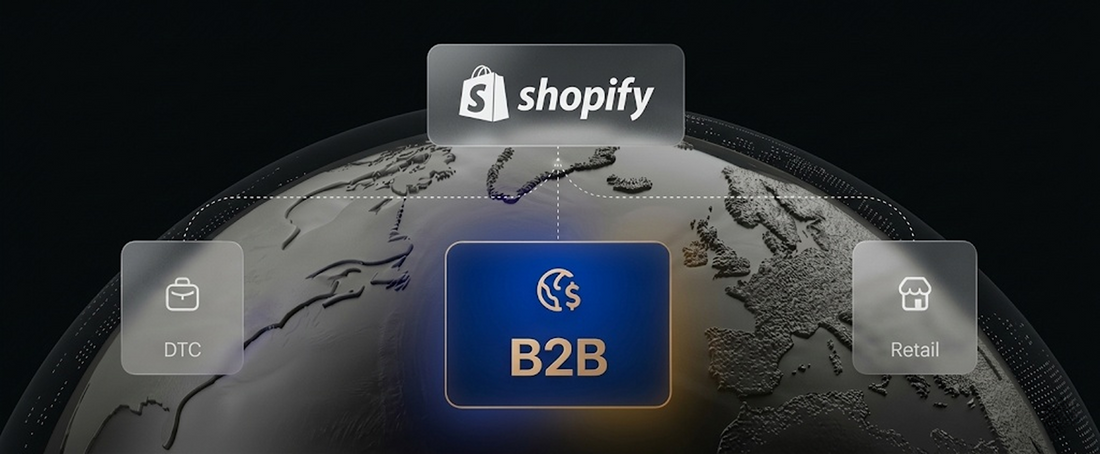

Shopify is the best commerce platform in the world. But if you're a manufacturer running contract pricing across dealer networks, a distributor juggling five ERPs from three acquisitions, or a parts business watching margins erode from wrong-part returns - you already know that the platform's native B2B capabilities don't yet cover the full picture.
B2B commerce is not standard add-to-cart ecommerce. It's bulk ordering across large catalogs. It's multi-step approval processes, configurable made-to-order products, CPQ workflows, job-specific project lists, reorders, quoting, spare parts management, services, and where-to-buy functionality. These are not edge-case requirements - they're the baseline expectations of professional buyers. And they demand a fundamentally different approach to both front-end experience and back-end architecture.
We know because we've operated inside these environments for years. The same patterns surface repeatedly: approval workflows held together with duct tape, buyers forced to manage separate logins for every company they purchase on behalf of, and pricing models so complex that the ERP and the storefront are never quite in sync. The cost of that fragmentation compounds with every order, every manual reconciliation, and every failed replatform attempt.
The Patterns That Kept Showing Up
Work closely enough with complex B2B merchants and you stop seeing one-off problems. You start seeing systemic ones. Here's what we observed across manufacturers, distributors, automotive brands, and industrial suppliers - long before we productized any of it.
Multiple roles, zero workflow. A buyer at a large account doesn't operate alone. There's a procurement team member placing orders, a manager who needs to approve them, and an administrator overseeing the account. Shopify's native B2B tools don't yet support multi-role approval workflows at the level enterprise buyers require. The result: orders either bypass governance entirely, or teams revert to email chains and spreadsheets to get sign-off. That's not an inconvenience - it's an operational risk that compounds with every order.
Selling everywhere, but managing nowhere. B2B organizations don't just take orders through a storefront. Orders come in through sales reps, phone calls, emails, PDFs, and EDI - alongside self-serve digital channels. The quote-to-order process is fragmented across systems, with no unified view of what's been quoted, approved, or fulfilled. Unifying that flow - online, offline, rep-assisted - into a single commerce layer is one of the most persistent challenges we encounter.
One buyer, many entities. A single person - with one email address, one login - may purchase on behalf of multiple companies, divisions, or subsidiaries. Shopify's data model ties a customer to a single company. Without solving this, organizations either maintain multiple accounts per user (creating data fragmentation) or lose visibility into who is purchasing for whom. Layer in buy-on-behalf-of and impersonation requirements for sales teams, and the gap widens further.
Pricing that demands the ERP as source of truth. When a merchant has thousands of SKUs, thousands of customer accounts, and billions of possible pricing combinations - factoring in manufacturer discounts, volume tiers, contract terms, and regional rules - the ERP must remain the authoritative source for pricing and customer hierarchy. Batch syncing creates data drift. Inaccurate pricing on the storefront doesn't just create a poor buyer experience - it creates revenue leakage and erodes account trust. For the most complex merchants, live price lookups that pull directly from the ERP at the moment of purchase are the only viable approach.
These aren't edge cases. They're the operating reality for any B2B operation of meaningful scale.
Why We Build on Shopify's Extensibility Framework
There's a reason we didn't build a standalone B2B platform. And it's the same reason we advise our clients to stay on Shopify rather than migrate to a legacy B2B system or a heavily customized open-source platform where upgrades become impossible because of the modifications made to the core.
Extensibility, in the Shopify context, means building on top of the platform's APIs, data model, and infrastructure rather than modifying or forking the core. It's the difference between extending a platform and customizing it beyond recognition. When you extend, you inherit every performance improvement, security patch, and feature release Shopify ships. When you customize the core, you create a version of the platform that only you maintain - and every upgrade becomes a migration project.
Shopify provides native performance, security, a world-class checkout, and an ecosystem that no bespoke platform can replicate. Shopify B2B is built on top of Shopify's core product - and Teifi leverages the platform's extensibility framework in every build. This is a deliberate architectural choice: what we build is as scalable as Shopify itself, because it's built on the same foundation.
"Shopify solves the hardest problems in commerce - performance, checkout, and global scale. The challenge for complex B2B isn't replacing that foundation, but extending it in the right places. That's where our work sits." - Frank van der Heijden, CTO, Teifi Digital
When Shopify ships native features that overlap with something we've built, that validates the pattern. In the meantime, our clients aren't waiting for the roadmap. They're already operating with these capabilities in production.
We've had direct conversations with Shopify's team about their B2B plans. Where they've confirmed that certain capabilities aren't on the near-term roadmap, we've built with confidence - knowing that our solutions fill a real, acknowledged gap.
Shopify is an 80/20 platform by design - it gets most merchants the vast majority of what they need, out of the box, faster than any alternative. That ratio is what makes it the best commerce platform in the world. For complex B2B, the math shifts. The platform provides a strong foundation - roughly 60% of what an enterprise manufacturer, distributor, or parts business requires. The remaining 40% is where specialization becomes essential: approval workflows, multi-entity management, ERP-driven pricing, fitment logic, and deep systems integration. We've spent years building specifically for that gap - and in our next piece we'll show you exactly what that looks like in practice.