
In our previous post we laid out the patterns. The fragmented workflows, the pricing drift, the multi-entity chaos that enterprise B2B teams navigate every day.
Today, we're launching Teifi B2B Commerce Suite - and here's what we built, and the merchants already running on it.
This is not a single feature or a bolt-on app - it represents years of investment in extending the Shopify platform - accumulating best practice and intellectual property into a suite of purpose-built features, private applications, connectors, a proven B2B theme architecture, and a systems integration methodology.
It breaks down into three layers.

The front end: purpose-built B2B theme architecture
We've built a Shopify theme layer designed specifically for B2B buying experiences - prioritizing performance, ease of use, and research-backed B2B design patterns informed by frameworks like the Baymard Institute's B2B UX guidelines. This isn't a D2C theme repurposed for wholesale. There's a meaningful difference between a blended D2C/B2B storefront and a purpose-built B2B buying experience - and most merchants need the latter. It's built for buyers who need fast navigation through large catalogs, complex product configurations, and workflows like CPQ that don't exist in standard commerce themes. That includes search systems that recognize product codes, part numbers, and trade terminology - not just consumer keywords - as well as Quick Order tools with XLS import/export and intuitive navigation designed around how B2B professionals actually work.
Capabilities and workflow features
These are the purpose-built features, private applications, and connectors - built and maintained by Teifi - that extend the platform into enterprise B2B territory:
- Order Approval Flows route orders to the right approver within the account before anything ships, enforcing compliance and keeping purchasing authority where the business requires it.
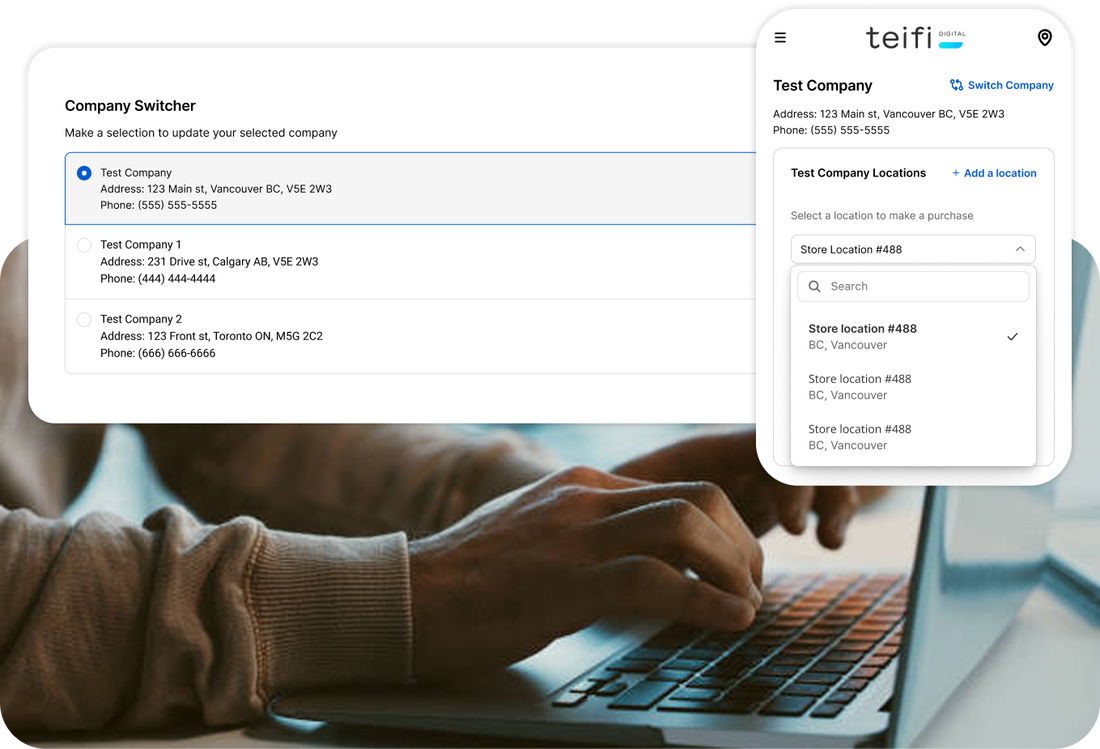
- Multi-Entity Management lets a single buyer toggle between the companies, divisions, or subsidiaries they're authorized to purchase for - with pricing, catalogs, and order history updating in real time from a single login. Sales teams can also impersonate and buy on behalf of customers.
- ERP-Driven Pricing & Customer Hierarchy connects directly to the ERP as the source of truth, so buyers always see accurate, account-specific rates. This eliminates data drift from batch syncing and supports contract pricing, volume tiers, and regional pricing rules. Credit limits, payment terms, and account hierarchies are synchronized in real time.
- Unified Order Payment enables merchants to process payment for ERP - and CRM-sourced orders through Shopify - including the ability to pay for multiple orders at once. This unifies the payment layer regardless of where the order originated.
- Advanced Role-Based Access Control defines granular permissions within a company account, including support for third-party identity providers.
- B2B Subscriptions allows buyers to set auto-renewals for specific products or orders, with full control over frequency.
- Job Lists & Wishlists let buyers create, save, and reuse project-specific product lists - accelerating reordering for recurring or job-based purchasing.
- B2B Onboarding standardizes how new buyer accounts are created, verified, and provisioned with the right pricing, catalogs, and permissions.
For parts and aftermarket businesses, Teifi Parts - one of several private applications built under Teifi Labs - brings fitment-driven discovery - Year-Make-Model search, MyGarage functionality (allowing fleet managers to save and shop for multiple vehicles), and compatibility logic - directly reducing wrong-part orders and the costly returns that follow. Multi-Entity Management and Teifi Bridge are also purpose-built Teifi Labs products, each maintained and evolved as part of our core IP.
Teifi Bridge: The Orchestration Layer
Many of the merchants we work with don't operate on a single ERP. They've grown through acquisition. They run Sage in one region, Epicor in another, and Dynamics 365 in a third. Their inventory, pricing, and customer data live in completely separate systems - and the cost of that fragmentation shows up in every order, every price discrepancy, and every manual reconciliation.
This is where Teifi Bridge sits.
Bridge is our proprietary integration and orchestration layer between Shopify and however many backend systems a merchant operates. When a buyer places an order on a single, unified Shopify storefront, Bridge identifies which company placed it, which region they belong to, which ERP should receive it, and which sales rep is attributed to the account - then routes accordingly. For merchants with drop-ship or distributed fulfillment models, Bridge handles order routing to the right suppliers and warehouses automatically.
We approach integration across three dedicated streams:
- ERP for order synchronization, pricing, inventory, and customer hierarchy,
- CRM for synchronizing offline and online order data and enabling payment for orders originated outside Shopify, and
- PIM for product contextualization, enrichment, and catalog governance.
Each stream is architected to preserve the authority of the source system while making Shopify the operational hub. Bridge is what makes that possible across multiple systems simultaneously.
Without Bridge, the alternative is typically one of two costly paths: run separate Shopify stores for each ERP or region (multiplying subscription costs, management overhead, and customer experience inconsistency), or build complex workflows in an iPaaS like Boomi or MuleSoft that require duplicating logic for every scenario - often at significantly higher ongoing cost. Both approaches create technical debt that compounds over time. Bridge replaces them with a single middleware instance that makes intelligent, automated routing decisions, at a fraction of the OPEX.
Each Bridge deployment is fully containerized, namespaced per client, and hosted in a Kubernetes environment with auto-scaling and built-in rate limit handling - delivering real-time sync capabilities without introducing third-party platform constraints. In production, Bridge is processing over 10 million webhooks and 2.7 million API calls, with at least 99.5% uptime.
We've connected Bridge to Epicor (Kinetic, Prophet 21), Sage (100, X3), Microsoft Dynamics 365 (F&O, BC), Acumatica, Infor (CloudSuite, SX.e, M3), NetSuite, Salesforce, Akeneo, and many more - often multiple systems within a single merchant environment.

Proven in Production
Teifi B2B is running in production for enterprise merchants today. The question of whether Shopify can handle complex B2B at scale has already been answered - by the merchants operating on it.
Guillevin, one of North America's largest electrical and industrial distributors - 11,000+ B2B customer companies, 104 locations across Canada - moved from Optimizely and Epicor P21 to Shopify. Teifi delivered live pricing pulled dynamically from P21 across over 1 billion unique pricing combinations, 120,000+ active SKUs, multi-region store support, product rules for units, bundles, and volume tiers, contextual inventory visibility across all locations, and full company switching and order approval flows. This is one of the most complex B2B merchants currently operating on Shopify - and it's live now.
"Teifi's B2B work on Guillevin shows that complex B2B operations, from massive catalogs to ERP integration, run on Shopify at enterprise scale. When a 120-year-old distributor like Guillevin builds here, it shows the market that Shopify can deliver the B2B experience their buyers demand."
- Dustin Holmstrom, Field CTO, Shopify
EVI Industries, a publicly traded commercial laundry distributor, unified five separate ERP systems into a single Shopify-powered customer portal - with 1.4 million pricing records reconciled in real time through Teifi Bridge. Multi-account and multi-location management replaced what had been fragmented service workflows with no self-serve capability.
Chem-Impex, a chemical supplier with an archaic ERP and a limited ecommerce platform, faced compliance bottlenecks for new buyers and confusion around hazardous material shipping fees. After migrating to Shopify with Teifi B2B: 28% improvement in average order value, 2x returning clients, and up to 80% growth in total sales.
Royal Distributing, Canada's powersports leader, consolidated over 1 million SKUs and 700+ vendors onto Shopify - with B2B, D2C, and POS unified on a single platform. Teifi Bridge powers custom order routing to suppliers and drop-ship orchestration. The result: 50% reduction in technology support costs and significantly reduced internal technical overhead.
Extending Shopify for the Complexity B2B Demands
This is a fundamentally different proposition than starting from scratch with every engagement. It means faster launches, lower total cost of ownership, and significantly less architectural risk. And everything we've described in this post represents the starting point, not the boundary. There are capabilities under the surface - advanced quoting flows, CPQ configurations, complex onboarding workflows, custom role structures - that surface during discovery based on the specific complexity of each merchant's business.
When we go deeper into requirements, it's more likely than not that we've already built - or started building - a solution for what's needed. That's what years of investment in extending Shopify for enterprise B2B produces: not just a set of features, but an accumulated depth of intellectual property purpose-built for this space.
If your business runs on complex B2B workflows, multiple ERPs, or high-SKU catalogs with intricate pricing logic - and you've been told that Shopify can't handle it - it's worth evaluating whether your current commerce architecture is solving those problems, or simply working around them.